
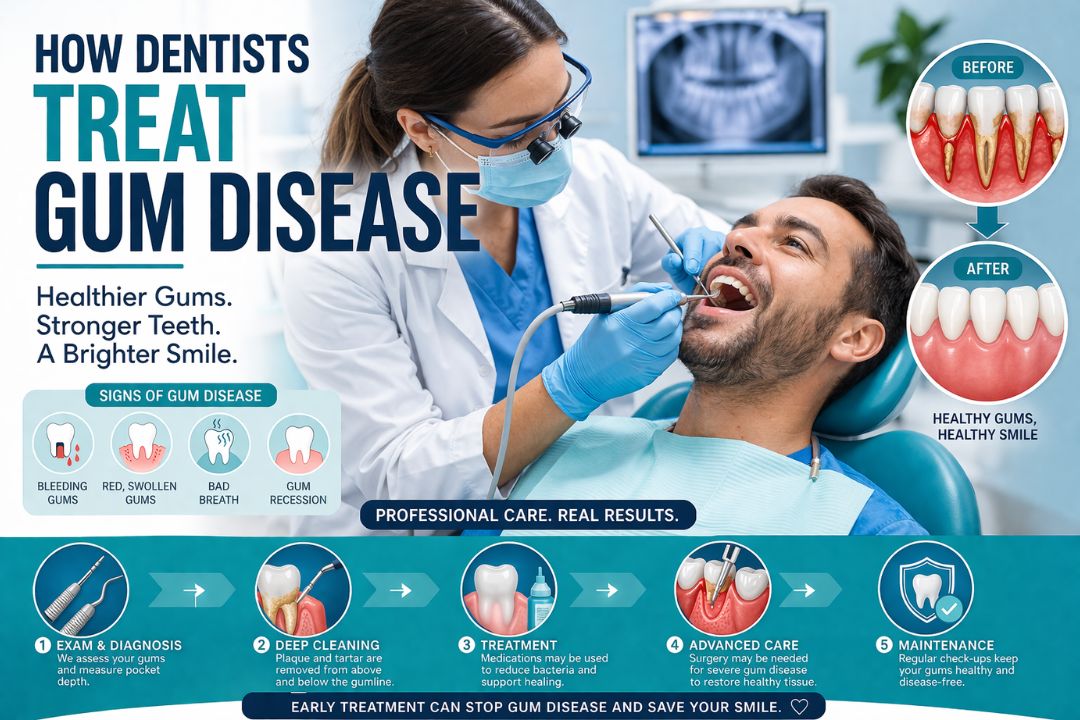
Gum disease is one of the most common oral health problems, but many people do not realise how serious it can become if left untreated. It usually starts as gingivitis, which causes red, swollen, or bleeding gums. If it is not treated early, it can progress to periodontitis, a more advanced form of gum disease that can damage the tissues and bone supporting the teeth. Health authorities including the NHS, CDC, and NIDCR all describe this progression and note that early treatment gives the best chance of controlling the problem.
The good news is that dentists can treat gum disease, and in many cases they can stop it from getting worse. The exact treatment depends on how advanced the condition is. Some patients only need professional cleaning and better home care, while others may need deep cleaning, medication, or periodontal surgery. The main goal is always the same: remove plaque and tartar, control infection, reduce inflammation, and protect the teeth and gums for the long term.
Dentists start with a full gum assessment
Before choosing treatment, a dentist will examine the gums carefully. They will usually look for redness, swelling, bleeding, gum recession, plaque buildup, loose teeth, and bad breath. In many cases, they will also measure the spaces between the teeth and gums, often called periodontal pockets. These measurements help show whether the disease is mild, moderate, or advanced. If needed, dental X-rays may also be taken to check if there has been any bone loss around the teeth. The CDC and NIDCR both note that periodontitis involves deeper tissue and bone support, so proper assessment is important before treatment begins.
This first stage matters because gum disease is not treated the same way in every patient. A person with mild gingivitis may improve with relatively simple care, while someone with periodontitis may need multiple treatment visits and ongoing maintenance.
Professional cleaning for early gum disease
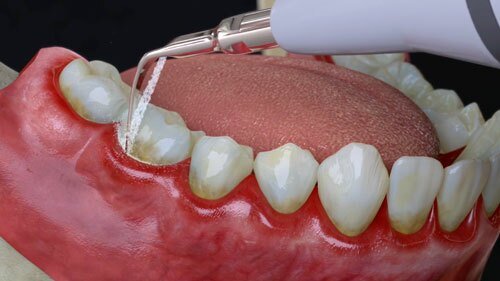
If the dentist finds early gum disease, especially gingivitis, treatment often begins with a professional cleaning. This removes plaque and tartar from the teeth and around the gumline. Tartar cannot be removed by normal brushing at home, so professional cleaning is essential once it has formed. NIDCR explains that gingivitis is usually reversible with good daily brushing and flossing together with regular cleaning by a dentist or dental hygienist.
At this stage, the dentist or hygienist will also teach the patient how to clean the teeth properly at home. This usually includes brushing twice a day, cleaning between the teeth, and improving daily plaque control. The NHS and CDC both recommend strong home care habits because gum disease often starts with plaque buildup that is not being removed effectively.
For many patients with gingivitis, this combination of professional cleaning and better home care is enough to reduce inflammation and stop bleeding gums.
Deep cleaning for periodontitis
When gum disease has progressed beyond gingivitis, dentists often use a treatment called scaling and root planing, also known as deep cleaning. This is one of the most common non-surgical treatments for periodontitis. The CDC describes scaling and root planing as a procedure that cleans the affected tooth and root surfaces below the gumline, while the ADA notes it as a standard nonsurgical treatment for chronic periodontitis.
Scaling removes plaque, bacteria, and tartar from above and below the gums. Root planing smooths the root surfaces so the gums can heal and reattach more effectively. This treatment helps reduce pocket depth and makes it harder for harmful bacteria to collect again.
Deep cleaning is often done over one or more appointments, depending on how many areas are affected. Some patients may receive local anaesthetic to keep the treatment comfortable. After treatment, the gums may feel sore or sensitive for a short time, but this usually settles as healing begins.
Medication may be used in some cases
Dentists do not always need medication to treat gum disease, but it can be helpful in certain situations. According to the CDC and ADA, treatment may include prescribed mouth rinses or medication placed directly under the gums, and some patients may receive antibiotics as an additional measure in selected cases.
However, medication is usually not the main treatment on its own. Dentists focus first on physically removing plaque, tartar, and infected material. Medicine is more of a support tool than a replacement for proper periodontal care. That is why patients should not expect a prescription alone to solve gum disease.
Dentists also address the cause
An important part of gum disease treatment is identifying the factors that are making the condition worse. Dentists often talk to patients about smoking, poor oral hygiene, missed dental visits, stress, certain medical conditions, and uncontrolled diabetes. NIDCR states that treatment success depends not only on professional care but also on daily home care and behaviour changes such as quitting smoking. The CDC also highlights smoking as a major risk factor for periodontitis and notes that quitting helps gums heal after treatment.
This means treatment is not just about what happens in the dental chair. It also includes what the patient does every day afterwards. A dentist may recommend a softer brushing technique, regular flossing or interdental cleaning, smoking cessation, and more frequent follow-up appointments.
Follow-up visits are a key part of treatment
One thing many patients do not realise is that gum disease treatment does not end after one cleaning. Dentists usually review the gums after treatment to see how well they are healing. The ADA notes that after scaling and root planing, the periodontal tissues need time to show the effects of nonsurgical therapy, and reassessment is important.
At the review visit, the dentist may check whether bleeding has improved, whether pocket depths have reduced, and whether the patient’s home care is working. If the gums are healthier, the next step is maintenance. If deeper pockets or inflammation remain, more treatment may be needed.
This maintenance phase is extremely important. Gum disease can return if plaque control slips, so many patients with a history of periodontitis need regular periodontal maintenance rather than ordinary occasional cleanings.
Surgery for advanced gum disease
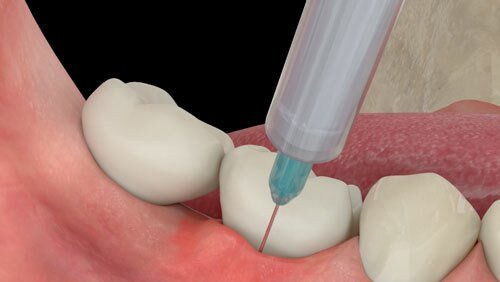
If gum disease is advanced and non-surgical treatment has not fully solved the problem, a dentist may refer the patient for periodontal surgery. The CDC, NIDCR, and NHS sources note that surgery may be used in more severe cases, particularly when deep pockets remain or when bone and gum support have been damaged.
One common option is flap surgery, sometimes called open flap debridement. In this treatment, the gums are gently lifted back so the dentist can clean deep areas around the roots more thoroughly. This can help reduce pocket depth and create a healthier environment that is easier to keep clean. NHS periodontal surgery guidance explains that this is often considered when deep pockets remain after thorough non-surgical treatment.
In some cases, regenerative procedures may also be used to help repair lost bone or tissue. The CDC notes that dentists may use small bits of bone in areas where bone has been lost or may move tissue to cover exposed roots.
Can gum disease be cured?
The answer depends on the stage. Gingivitis is usually reversible when treated early with professional cleaning and good home care. Periodontitis is different. It can often be controlled very successfully, but because it involves deeper damage to supporting tissues, long-term maintenance is usually needed. This is why early treatment is so important. NIDCR and the NHS both make clear that early care improves outcomes and helps prevent progression to more serious disease.
What patients can expect after treatment
After treatment, patients often notice less bleeding, fresher breath, and gums that feel firmer and healthier. Some mild tenderness or sensitivity is normal after deep cleaning, but the long-term aim is a cleaner mouth and more stable gum health. The dentist will usually advise the patient to keep up excellent home care and attend regular check-ups to stop the disease from returning.
Final thoughts
So, how do dentists treat gum disease? They begin by assessing the severity, then remove plaque and tartar, improve gum health through professional cleaning or deep cleaning, use medication when needed, and recommend surgery in advanced cases. Just as importantly, they help patients improve daily oral care and manage risk factors that can make the disease worse.
For Smile and Skin Co., the key message is simple: gum disease treatment is not just about cleaning the teeth. It is a step-by-step process focused on stopping infection, protecting the gums, and helping patients keep their natural teeth for as long as possible. The earlier it is treated, the easier and more effective that process usually is.

 and Innovation by